


By Bethany Sciortino | Director of Strategic Partnerships, FORUM | November 2026
The last thing I did at the NMHC Student Housing Conference was lose a closest-to-the-pin contest at a Top Golf in the desert.
In my defense, I was aiming for the wrong target. And I did get on the board - even if only for about four minutes, and after roughly twenty attempts to get there.
It was a good way to end the conference. Outside, in Arizona, at the end of October, sunset-lit mountains as a backdrop, with a golf club and a drink I had earned.
Three days earlier I had arrived at the Grand Hyatt Scottsdale Resort for NMHC's last standalone Student Housing Conference. Two days later I would get on a plane and fly to Chicago for NIC's Fall Conference, where nearly four thousand people gather to talk about the other end of life.
Students, then seniors. Five days, two time zones, two asset classes that most of the industry keeps in separate drawers.
At FORUM, we design both, on a shared foundation of forty years of multifamily. What they have to do with each other is the real story. I'll get to it. First, I have to climb a mountain.
The mountain before the meetings
The week actually started on Camelback Mountain, with partners from JLC Engineering, at dawn. I had extended my trip by two days to do some solo hiking in Sedona beforehand, which means I arrived at Camelback with legs that had already died and were now being asked to resurrect themselves.
There's a fine line between wellness networking and indulging in self-harm, because somehow the hike became a competition. I mean, my colleagues are, collectively, guys. Guys who are distance runners. Guys who are younger. About two-thirds of the way up I was negotiating with my own body in complete sentences, and I came very close to vomiting on the rocks in front of a seven-year-old boy. Instead, I cried on the inside, like a winner. Made it to the top, where the view was genuinely worth it - a great start to the week ahead.
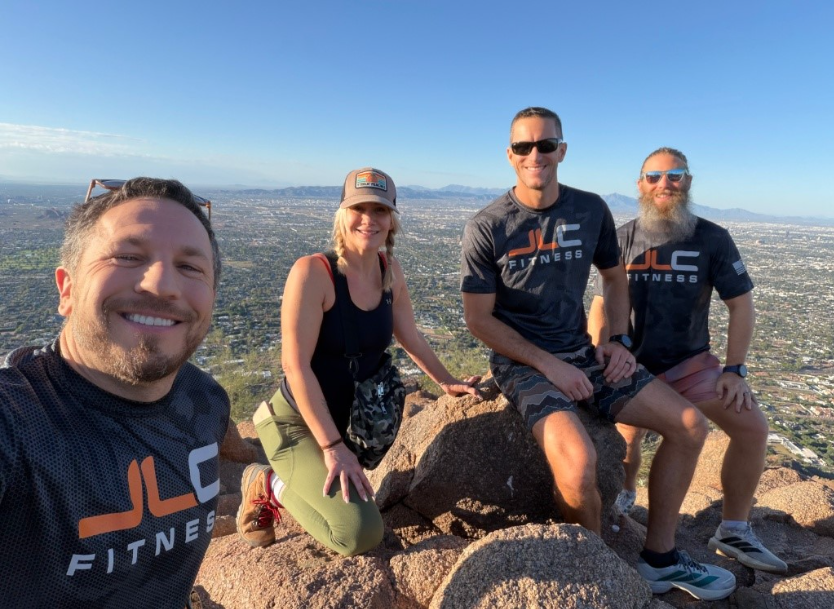
Dawn on Camelback. At the summit with partners from JLC Engineering before diving into the week in Scottsdale.
Amanda Froelicher, FORUM'S Studio Director who leads much of our student housing work, made the trip too, which meant I had someone to compare notes with at the end of each day.
When the room said enrollment, I heard my Tuesday
We sat down for the opening general session while my legs regained their feeling, and the room immediately started talking about enrollment.
This conversation landed closer to home for me this year. I have a senior and a sophomore, both up next for college, so when a panelist said "enrollment headwinds," I heard "your Tuesday." Also, my nephew is the number three high school defensive end in the country, with more than sixty Division I offers. That means I could corroborate the thing the room was describing: name, image, and likeness (NIL) dollars now doing the work that marketing budgets used to do, out-of-state applicants factored into the cost per admitted student, a family's decision shaped by a machine that has nothing to do with architecture.
His university choice will reinforce the trend the panel put on the screen - capital and demand concentrating around the Power 4 institutions with real national athletic and academic brands, and smaller colleges in smaller conferences looking at a softer outlook.
Yardi's numbers say the same thing with less emotion. Preliminary September occupancy across the Yardi 200 came in at 94.5%, level with last year, but their newer trending methodology lands nearer 92.1%, which tells you how much room the final figure still has to move. More than 31,000 off-campus bedrooms delivered in 2026, up twenty percent. Average rent $928 a bed, with leasing-season growth of 1.2% against 2.6% the year before, and occupancy down three hundred basis points in the ten markets that absorbed the most deliveries.
None of that is a demand crisis. It's a sorting-out, and the sorting is happening by institution rather than by market - and that matters far more to a pro forma than any national average.
Wellness is not an amenity
The other thing the conversation returned to was wellness, and not in the amenity-list sense. Quiet zones. Biophilic design. Natural-light study and decompression areas. Wellness walks, outdoor gathering, places to be alone in a building full of people. Affordability came up the same way: rents have grown, and students are making trade-offs inside the unit rather than outside the building. All the things FORUM thoughtfully and intentionally implements into the projects we design.
To close the conference, FORUM sponsored the Top Golf Mixer hosted by Wes Deese and the team at Student Housing Insight, benefitting Hi, How Are You? - the nonprofit that advocates for and supports student mental health. We spent three days talking about how nineteen-year-olds want to live, and then we helped raise funds for the people keeping them well. Right order of operations, if you ask me.
Then I lost at golf.
But the conversations and the insights were clearly a win.

Closing out Scottsdale. Bethany Sciortino and Amanda Froelicher at the Student Housing Insight Top Golf Mixer benefitting the Hi, How Are You? Project.
The other end of life, one flight away
Wednesday morning I flew to Chicago to meet Andrew Roark, Principal, for the NIC Fall Conference. I went from under 500 people to nearly 4,000 - bridged by one three-hour flight and one time zone, and pivoted from conversations around students just starting their lives to seniors navigating how and where to live during their final chapters.
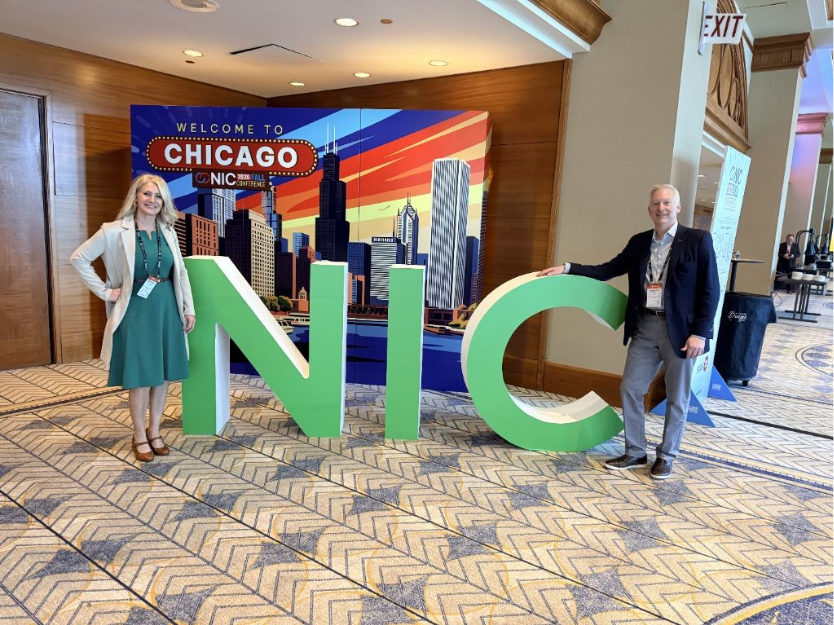
Pivoting to senior living. Bethany Sciortino and Andrew Roark arriving at the NIC Fall Conference in Chicago.
The conversation I found most inspiring was Ken Dychtwald's keynote on longevity - reimagining aging rather than merely extending it. The argument, as I heard it: we have spent a century adding years to life and almost no time adding life to those years. New longevity life stages. Matching healthspans to lifespans. Choices about how, and where, and how long we want to live.
(Sidebar kudos to Dychtwald who boldly challenged the industry to find an end to dementia, even if it risks putting operators out of business. I hope someone accepts.)
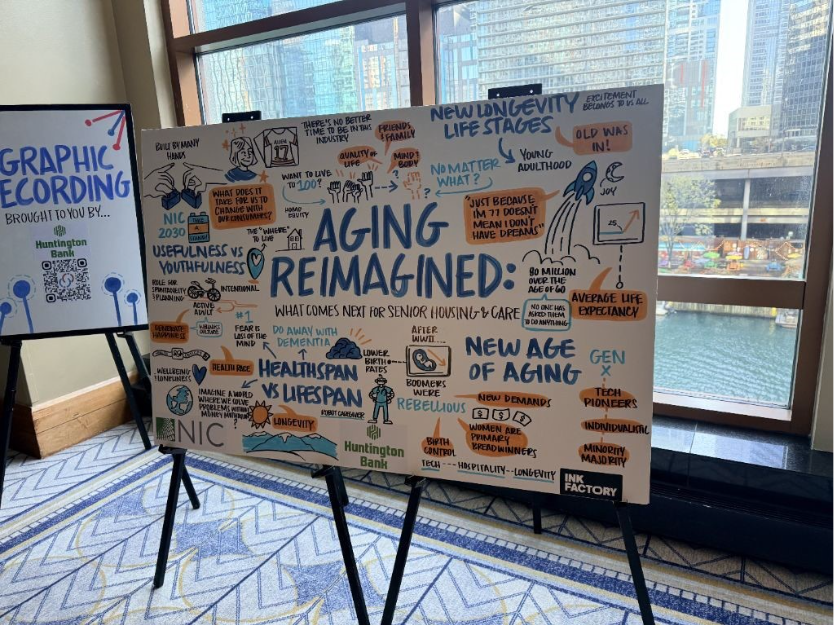
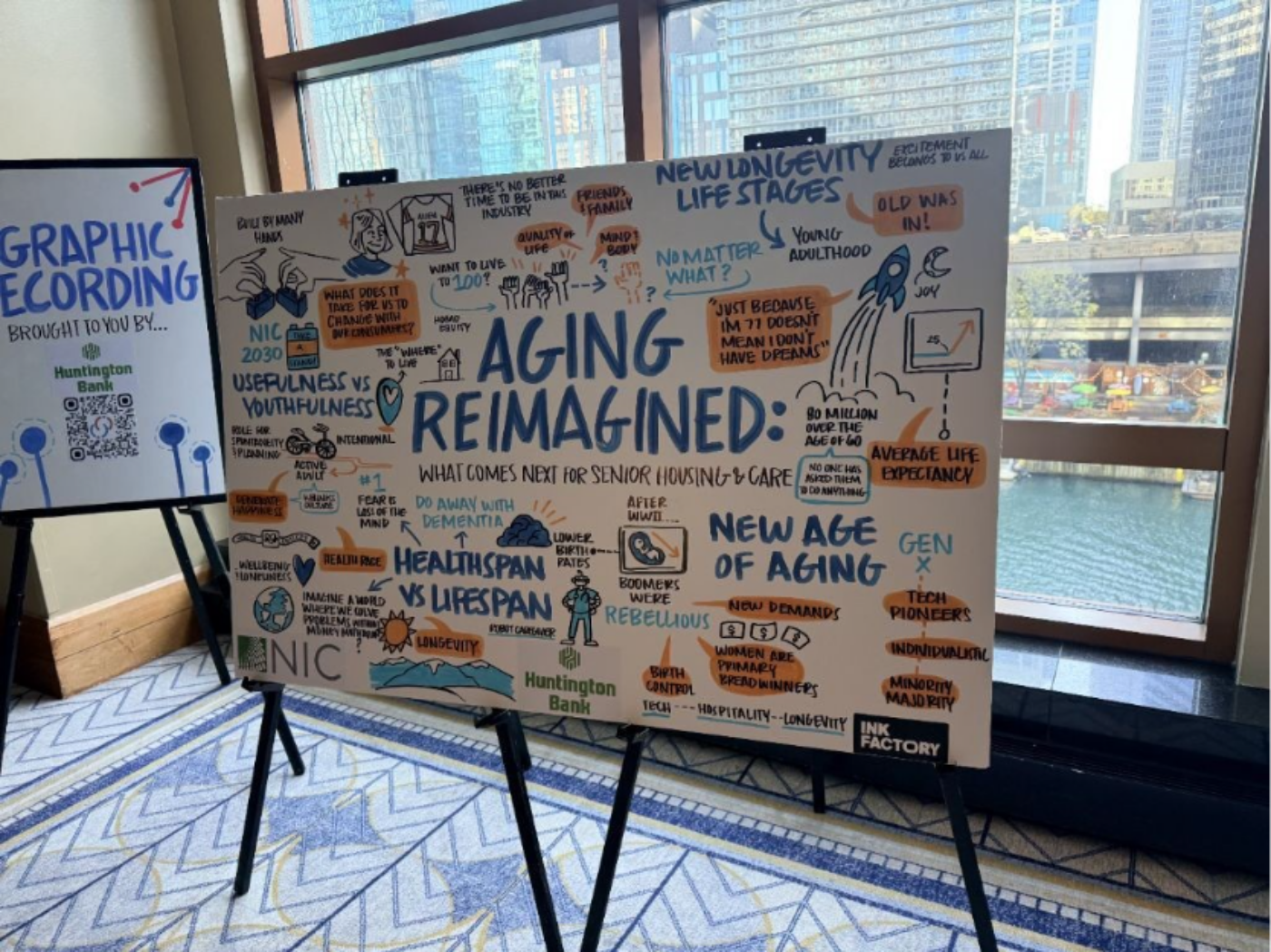
The board that did the most work all week. Aging Reimagined: What Comes Next for Senior Housing & Care - live graphic recording from the NIC Fall Conference in Chicago, by INK Factory.
Just because I'm 77
Two lines have sat with me since: Just because I'm 77 doesn't mean I don't have dreams. And, in a whisper behind it: no one has asked them to do anything.
What does this have to do with architecture and interior design? There are now 80 million people over the age of sixty - an entire generation arriving at the next stage of life while our industry has mostly designed at them, and for developers and owners. We have a responsibility to create a balance here: designing intentional communities that support healthspan as well as health care, and lifespan as well as life support.
Some universities have developed senior communities on campus, allowing older adults to contribute to business incubators and interacting with students and academia. This proximity to education and entrepreneurship as well as intergenerational interaction exponentially impacts longevity, and the wisdom of senior inspires young leaders.
It occurred to me that the two halves of my week were not opposites at all. They were the same design problem at two different ages, with the same person in the middle.
The asset class hiding in plain sight
Which brings me to the thing I actually want to say, and the reason I think 2027 is a different kind of year.
For the last several cycles, senior housing has been the harder conversation. Care licenses, clinical staffing, a capital stack that requires a specialist to explain. Student housing has been the easier one - build near the right campus, lease by the bed, hand it off.
That hasn't quite inverted; student housing is still a resilient asset class. But the clearest expression of that shift is the 55-plus active adult community. And there was a lot of talk around this model at NIC.
Active adult occupancy hit 93.2% in the third quarter, the highest level since 2024 and up 1.3 points since the end of last year. Buffalo reached 97.7%. Los Angeles and San Diego both came in at 97.4%. Even Phoenix, the weakest of the fifteen largest active adult markets, sat at 88.7%.
A 55-plus community doesn't carry a care license or a clinical staffing model. It underwrites like the multifamily most developers already know how to finance, which makes it dramatically easier to capitalize in a market where capital has become picky. But it also sustains something the care continuum struggles to: choice. Your own front door. Your own car. Your own Wednesday. The amenities that show up most often in NIC's data - fitness centers, clubhouses, pools, activity coordinators - are not care. They're life, with the maintenance removed.
"Easier to capitalize and better for the resident is not a pairing this industry gets often."
It's also where FORUM has been quietly working for years. We design 55-plus active adult alongside independent living, assisted living, and memory care - the same integrated team, the same four decades of sector-specific work, across a quarter of a million units throughout the country. The crossover is the point. The architects who detail a memory care floor plate are the ones who know exactly how wide a 55-plus bathroom needs to be so that it still works in fifteen years, when the resident who bought in at 62 needs a little more help and would very much like to stay put.
Which is the other half of the longevity story. Healthspan matching lifespan is a nice phrase until you're the one designing the door.
A tenth of what we need
Meanwhile, the senior housing numbers remain rudely consistent. National occupancy hit 90.4% in the third quarter - the twenty-first consecutive quarter of gains. Independent living at 91.7%. Assisted living at 89.1%. Sixteen of the thirty-one primary markets above 90%, with Boston at 94.0% and San Francisco at 93.3%.
And supply, which is the number that should keep everyone up at night. Just 16,159 units under development in the quarter. Inventory growth holding at 0.4% year over year. Across the top ninety-nine markets, units under construction fell below 24,000 - the lowest since mid-2012.
Holding occupancy at 90% as the population ages would require more than 100,000 new units in most years through the late 2030s. The current pace of development is roughly 10,445 units a year. About a tenth of the requirement.
Not if. When.
The last cycle made everyone cautious, but the math has run out of patience. The capital markets are starting to notice something the operators noticed a year ago: acquisition costs are catching up to replacement costs.
I'm not an analyst or a prophet, but I am an active observer and listener. And here is my call. New construction is no longer a question of if. It's a question of when, and "when" is closer than the pipeline suggests. I expect the next six to eight months to produce real traction - not a wave, but the first credible movement in senior housing starts in years, and the planning activity that has to precede it by a year. NIC's own read is that planning is picking up anecdotally before it shows in the data. In my experience, anecdotal very well could be a budget line by summer.
What that means for design is the part I care about. Arick Morton at NIC made the point that new construction alone won't close the gap - adaptive reuse, expansion of existing properties, and other creative approaches have to carry part of it. Every one of those is a design decision before it's a financial one. Whether a site can hold the program. Whether an existing building's bones will take the conversion. Whether the thing can get permitted inside a calendar year. Those questions get answered in the first sixty days, by people who either know the market or don't.
Shameless plug: guess who knows it? We do.
Nineteen and seventy-nine
This was my last big conference push of the year. On the flight home, somewhere over the middle of the country, is when I reflect - as well as play a few mindless games - and I have an optimistic desire to get into planning for 2027.
Two generations, one interesting common thread. Both are being designed by people who will never live in the building. Both are being paid for by someone in the middle - a parent writing a check, an adult child doing research on a Sunday afternoon. With college-ready kids and Boomer parents, I am, inconveniently, both of those people right now. That makes me the most difficult client - but I hope, a better educated development partner.
The design principles hold whether our residents are nineteen or seventy-nine. Light, quiet, a place to gather, a place to withdraw, and evidence that somebody thought about what happens on an ordinary or challenging day in their life - not just what turns profit.
The student version is a decompression room at eleven o'clock at night during finals. The senior version is a memory care retreat that feels familiar and like home. The vocabulary is nearly identical. Only the square footage and the care model change.
If you're staring at a pipeline and trying to decide whether it pencils, that's a conversation I, and the team at FORUM, would genuinely enjoy.
FAQs
It pairs the strongest occupancy in senior housing – 93.2% nationally in Q3 2026, the highest since 2024 – with the simplest capital structure, because it underwrites like multifamily rather than a licensed care product. That makes it easier to finance and better at preserving what residents actually want: choice and independence.
The math says soon. Occupancy has risen for twenty-one consecutive quarters to 90.4%, while units under construction have fallen below 24,000 – the lowest since 2012 – and annual development runs at roughly a tenth of what demand requires. As acquisition costs approach replacement costs, new construction becomes the rational choice, and planning activity is already picking up ahead of the published data.
Three things: whether the site genuinely supports the program, whether the deal pencils at today’s replacement and acquisition costs, and whether it can get permitted without an eighteen-month delay. Adaptive reuse and expansion of existing assets are increasingly viable alongside ground-up work, and design decisions made in the first sixty days determine all three.
Similar
Martin Manor: Rebuilding Affordable with an Eighty-Year History
Dixie Manor was among the oldest public housing communities in South Florida: born of a segregated wartime economy, sustained by generations of families, and...
Visualize Early. Design Better. Market with Impact.
At FORUM, we see visualization as a working tool, not a final step. Renderings help clients and design teams explore ideas, test massing, evaluate...